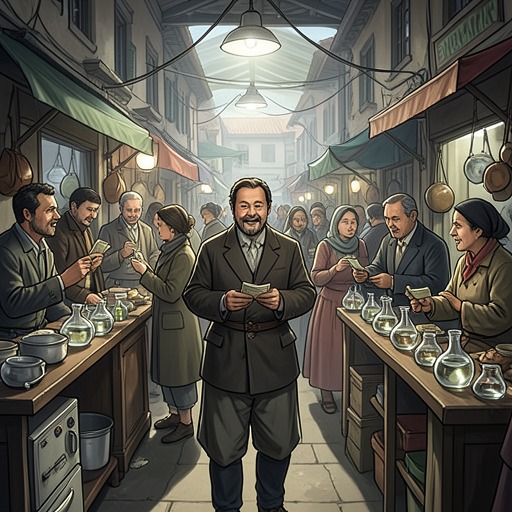
Fear sells
World War Z“Fear sells” is the governing expression of Breckinridge Scott’s prewar business philosophy, first learned from a history professor at Wharton and then applied to the outbreak of African rabies. Its decisive significance lies in the way it converts a basic human emotion into a mechanism of commerce and power: people do not merely buy products, but buy relief from the fear of living without them.
Definition and Origin
Scott recalls being told that “fear is the most valuable commodity in the universe.” The lesson overturned his assumptions about economics. He rejects the idea that global capitalism operated according to stable scientific rules, describing it instead as a gamble in which the durable principle was emotional: advertising succeeded by making people afraid of aging, loneliness, poverty, failure, or deprivation. The professor’s instruction to watch television clarified the mechanism. Commercials appeared to sell products, but beneath that surface they sold the fear of having to live without those products.
Scott reduced the lesson to a compact mantra, “Fear sells.” The expression is therefore both a slogan and a theory of the market. It identifies fear as primal, portable, and endlessly renewable: a consumer can stop needing a particular object, but can always be made to fear a new loss. The phrase’s bluntness also reveals Scott’s moral distance from the people whose anxieties generate his profits. Fear is not, in his account, a condition to relieve before doing business; it is the business opportunity.
Application to the Outbreak
When Scott first heard reports of what was still called African rabies, he immediately recognized the outbreak as an opportunity. The first report concerned the Cape Town outbreak and contained only ten minutes of factual coverage, followed by an hour of speculation about what might happen if the virus reached the United States. Rather than treating the speculation as irresponsible journalism, Scott understood it as market preparation. The broadcast supplied the atmosphere in which fear could be converted into demand.
He contacted his associates within thirty seconds of seeing the report. Together they developed a pitch for a genuine rabies vaccine, even though no cure for rabies existed. Scott regarded the absence of a cure as commercially useful: a cure would be purchased mainly by people who believed they were already infected, while a vaccine could be presented as prevention. As long as people feared that the disease remained somewhere beyond their immediate reach, they could be persuaded to keep buying protection against it.
The scheme depended on networks as much as on emotion. Scott and his partners had contacts in the biomedical industry, as well as connections on Capitol Hill and Pennsylvania Avenue. They believed they could produce a working prototype in less than a month and prepare a proposal within days; by the eighteenth hole, the agreement had been reduced to handshakes. The phrase thus describes a complete commercial chain, from televised speculation and public anxiety to scientific production, political access, and the prospect of recurring sales.
Fear as Institutional Power
The expression also illuminates systems beyond advertising. At Yeroham resettlement camp, quarantine was experienced as imprisonment, defined by tents, overcrowding, guards, barbed wire, and the baking Negev sun. Daily examinations of blood, skin, hair, saliva, urine, and feces made medical knowledge inseparable from bodily exposure and administrative control. The examinations were made more bearable because many of the medical personnel were Palestinian, including a former detainee from Jabaliya in Gaza who insisted that the refugees had made the right decision. Yet the camp’s promise of safety was inseparable from surveillance, classification, and the fear of infection.
The Redeker Plan gives the same logic a military form. Because the armed forces could not save everyone, a small civilian fraction would be evacuated to a defended safe zone to provide labor and preserve governmental legitimacy. Those left outside would be kept alive as “human bait,” isolated, defended, and resupplied where possible so that the undead would remain concentrated away from the retreating army. Here fear is no longer merely marketed to individuals. It is organized spatially and administered as policy: the terror of the undead becomes a resource used to protect a selected population.
The Russian punishment system similarly turns fear into collective discipline. Soldiers accused of treachery are told that they will practice democracy by voting on which member of each group of ten will be executed, after which they must personally kill their friend with stones. The method binds the survivors not only through fear of punishment but through guilt and complicity. Its power comes from making people participate in the violence that governs them, allowing them afterward to retreat into the excuse that they were only following orders.
Consequences and Wider Echoes
The expression’s reach extends into reconstruction and social management. Postwar authorities confront a civilian workforce in which more than 65 percent are classified F-6, possessing no valued vocation. A postindustrial economy has produced executives, representatives, analysts, and consultants, but reconstruction requires carpenters, masons, machinists, and gunsmiths. Retraining therefore becomes a form of survival policy, forcing white-collar workers into practical labor while roads, railways, fuel supplies, and the old commuter infrastructure remain broken. Fear of extinction makes formerly specialized identities expendable and turns labor into a national resource.
It also shapes the treatment of bodies regarded as useful or dangerous. Military dogs are first used in triage to identify the infected by smell, following the Israeli method of sending people past dogs in cages. The procedure exploits the animals’ terror response, even though early panic causes dogs to attack handlers and other people. Handlers lose hands, arms, and throats, but the same instinct that makes the animals dangerous is credited with saving millions of lives. Fear is thus transformed into a screening instrument: an involuntary biological response becomes a technology of public safety.
In Russia, reproductive policy gives the phrase a nationalistic and intimate consequence. Young fertile women who survived drugs, AIDS, and the presence of the living dead are treated as scarce strategic assets. The leader declares that the greatest weapon a Russian woman can wield is her uterus, and the speaker accepts service to the motherland even while acknowledging that she may not know the fathers of her children or, eventually, her children themselves. The language of protection has become the language of mobilization, and fear of demographic weakness converts reproduction into military duty.
The most overt political version appears in the invitation extended to the interviewer entering Russia. The visitor is told that the authorities want the stories heard abroad so that other nations will understand what would happen if they challenged Russia. The war is presented as having restored Russian roots, strength, fear, and safety beneath the protective fist of a Caesar. The same emotional structure that once sold a vaccine now sells obedience to centralized power: insecurity creates the appetite for protection, and protection legitimizes domination.
Narrative Significance
“Fear sells” begins as Scott’s personal maxim, but the surrounding testimony steadily enlarges it into a recurring pattern of the postwar world. Commercial advertising, quarantine medicine, selective evacuation, military punishment, labor retraining, canine triage, reproductive policy, and nationalist propaganda differ in purpose and scale, yet each attaches security to a managed fear. The narrative does not suggest that every protective measure is fraudulent; many are presented as necessary responses to an existential emergency. Its darker observation is that necessity does not prevent fear from becoming profitable, disciplinary, or politically useful.
The phrase also links private calculation to public catastrophe. Scott sees a television report and imagines a vaccine market; governments see the undead and imagine safe zones, bait populations, controlled borders, or obedient citizens. In each case, the threat is real, but the response depends on how the threat is framed and who controls that framing. “Fear sells” names the moment when terror stops being only an emotion and becomes a product, a policy, or a principle of rule.